Showing posts with label Dragons. Show all posts

Tuesday, March 3, 2015

The Little Ones: Terrible Terrors & Friends

Sorry for the delay, I have had problems posting to blogger lately. But finally here is the next post for the HTTYD series.

Not all the dragons in the how to Train your dragon franchise are large, many are dog sized or smaller. The smallest are the insect-sized nanodragons but today we are going to look at those species commonly kept as pets and hunting dragons.

The most common in the movies is the Terrible Terror, a breed the size of a large house cat. The most common in the books is the dog sized Common garden and Basic brown breeds. The last is the Horrible Horror, my own hunting dragon according to This Website.

These small dragons may not be ridden but they can carry messages for the PCs (or NPCs for that matter), act as scouts, help hunt down dinner, be familiars, or simply be the team pet.

Terrible Terrors


Tuesday, January 6, 2015

Hideous Zippleback & Snaptrapper: Two (or more) heads are better then one

It has long been said that two heads are better than one and in How to Train Your Dragon this is true of two breeds of dragon, the Hideous Zippleback and the Snaptrapper. Here are the statistics for these multi-minded wyrms for In Harms Way: Dragons.

The two headed Zippleback is also known as the Two-Headed Gormatron in the books. While often thought to have a head on both ends like a Pushmi-pullyu the picture does show a tail thus indicating that this is actually a case of wonky perspective. In any case it is obvious that the movie zippleback is based on this breed.

Original Version of the Zippleback, the Two headed gormatron

The other breed featured here is the Snaptrapper. Found only in the movies this breed has four heads and resembles a beautiful tropical blossom.


The lifecycle of the snaptrapper
 
So look below for the perfect breeds for those role players who want to share large dragon and can't agree who should be the captain. 

Tuesday, November 25, 2014

The Marsh Tiger & Monstrous Nightmare

Here are the two more How to Train Your Dragon breeds for In Harms Way-Dragons! The Marsh Tiger and the Monstrous Nightmare. These breeds are so similar they are hard to tell apart at first glance but remember four legs is a water loving tiger and two legs is a flaming nightmare.


Tuesday, November 18, 2014

Friday, October 31, 2014

Converting the Gronckle

The previous post gave the basic information needed to convert the dragons from the HTTYD franchise to the In Harm's Way: Dragons! rules. Here is an example to show how to use these charts and the first breed for this series of posts: the Gronckle.

Wednesday, October 29, 2014

How to Train Your Dragon Conversion for In Harm's Way: Dragons!

Well my printer/scanner/copier died so I still don't have the images I needed for my cryptid post so instead I am going to make a series of posts for In Harm's Way Dragons!
 
This rpg allows for playing dragons and their riders during the Napoleonic wars much like in the Temeraire novels by Naomi Novik.  Not much has been done to support this game so I decided to fix that with a supplement for playing in the Orient.
 
I am currently working on a Viking expansion and that immediately got my family wondering about the How to Train Your Dragon franchise. While my version is historical I figured out a way to convert the dragons in both the books and movies to In Harm's Way statistics.
 
To make things easier on my fingers I am going to abbreviate How to train your dragon to HTTYD and In Harm's Way: Dragons to IHWD.

Monday, June 30, 2014

Mokèlé-Mbèmbé, Part 5: “The Real Brontosaurus of the Congo”

This very inaccurate  reconstruction of a Diplodocus is similar to what is being described from Lake Tele.


In the previous chapter, I told of the various expeditions to the Lake Tele area in search of a living brontosaurus. According to native descriptions the animal is 5-10 m (15-30 feet) long, much of which is neck and tail, with scaly reddish-brown to gray skin, a snake-like head that has a sort of fleshy frill on the back (which is often compared to a rooster’s comb in texture), and three webbed toes at the end of short legs. It may also have filaments growing on its head or neck and two pouches or pocket-like depressions near the junction of its neck and shoulders. The creature hides in the mud during the day with only its nostrils showing and travels and feeds mostly at night. It floats in the water, stretching its neck out to pluck fruit hanging from vines that lay low over the water. 

As any paleontologist will point out this description sounds nothing like a sauropod of any kind. In some ways, it is reminiscent of the older water dwelling dinosaurs of the 1020s to 1960s but in others, it is radically different than even those outdated theories.  This has caused some to dismiss the reports as either wishful thinking or accounts of a new species of lizard. However, there is a simple logical answer to the Congo sauropod reports and this answer was discovered way back in 1981.

Monday, April 7, 2014

Mokèlé-Mbèmbé, A Living Dinosaur? Part 3: Kasai Rex & Afroraptor

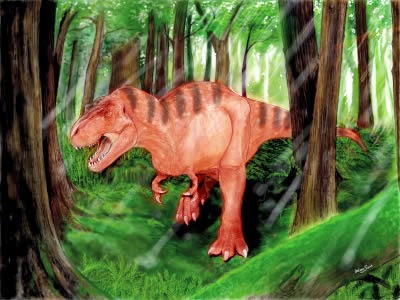
Artist impression of the Kasai Rex obtained by modifying clip art


Kasai rex is a darling of the internet. No discussion online of African dinosaurs can be made without someone claiming that the Kasai rex must be real because we have photos. The Kasai rex is supposedly a living Tyrannosaurus rex (and it is always T. rex rather than any theropod that was actually indigenous to Africa) that stomps about the Congo like Godzilla.

The glamor of this huge carnivorous theropod seems to cause people to lose their objectivity. I say this because as soon as one does even a few minutes of research the Kasai rex story dissolves into a huge pile of steaming manure.

Thursday, April 3, 2014

Mokèlé-Mbèmbé, A Living Dinosaur? Part Two: Native Art

Kuppenhole Rock Art


In the last post I reviewed the earliest reports of the so-called African Dinosaurs and found them inconclusive at best and outright hoaxes at the worst.  Several of these early sightings mention native rock art of these mysterious saurians. Maybe they can clear up the puzzle? 

Monday, March 3, 2014

Mokèlé-Mbèmbé, A Living Dinosaur? Part One: 1776 to 1939

Mokele-Mbembe according to Roy P. Mackal


Mokèlé-mbèmbé is a legendary water-dwelling creature of Congo River basin folklore, claimed to be a living sauropod by creationists and many cryptozoologists. In addition to a sauropod some claim there are living sivatheres, ceratopsians, stegosaurs, and even tyrannosaurs in the African Congo. To these people Central Africa is an actual Lost World that will disprove evolution

Unfortunately, no matter how much I would love to see a living dragon, once the actual reports are consulted the claims fall apart into wishful thinking, misquoted scientists, reports of known animals, reports of an unidentified rhinoceros, and hoaxes.

Sunday, August 18, 2013

Repticulus goes off with a bang! (Sorry I couldn't Resist)

I was going to blog about the so-called living dinosaurs in Africa, Really I was, but then I saw a comic book that just blew my mind. I just had to blog about it because really someone has to. This post is rated PG-13 and is unsuitable for little children even though it was originally written for children back in June 1962 and was approved by the Comics Code Authority!

Holy Cow where to begin...

Note how the ice Age was 50 MYA (Roll Eyes)

Tuesday, March 12, 2013

Dragonets, Firelizards, and Faerie Dragons

 
Original US cover for Anne McCaffrey's Dragonsong, the first of the Harper Hall trilogy

 Dragons were now in danger of becoming too familiar, even cozy. One sign the dragon was in trouble as a true monster, even threatened with terminal decline, was the appearance of the cute “shoulder dragon” – a creature with all the traditional attributes of dragonkind except size and convincing ferocity.
The following quote from the role playing game supplement Gurps Dragons is typical of the attitude modern books have towards the concept of  small dragons. If it's not a D&D super-wyrm than it's a modern fabrication of little worth. Unfortunately for the research abilities of these so called experts the tiny dragon is hardly the creation of modern fantasy, SF, and superhero stories. Anne McCaffrey did not invent the shoulder dragon, as is often claimed, such creatures have been a part of western folklore for thousands of years. And all of these real folkloric dragonets are far more interesting than tiny dragon pets with stingers or funny dog-dragon's that explode when kicked!

Paul Kidby's depiction of Terry Pratchett's swamp dragons

Tiny dragon-like creatures are commonly found in northern European folklore. These creatures (usually having a mix of the characteristics of both faeries and dragons) are known under many names including kratchens (Belgium and Holland), krats (Scandinavia), drachens (Germany), feu draks (France and Switzerland), aitvaras (Lithuania), lideric (Hungaria), pisuhand (Baltic areas), and tulihand (Estonia). The descriptions vary according to local folklore but are generally they are shapeshifters that appear as little house fairies that smell like rotten eggs, wear red caps and white tunics. They can turn into black cats or chickens in order to blend in with the household but when they fly they become winged 2-3 foot long four-legged dragons with a flaming tail. They thus are compared to a will o' wisp or tiny flaming ball.

Unsurprisingly, fairy drakes are also said to guard treasures when encountered in their will o' wisp form. This description changes in Finnish folklore where the krat is always depicted as a tiny dragon, yet still is depicted as a house fairy. Other names are Rarash, Kaukas, Pūkis, Damavykas, Sparyžius, Koklikas, Gausinėlis, Žaltvikšas, and Spirukas.

Typical d&d version of a Faerie dragon courtesy of AFSA clipart
 According to legend these little dragons are very loyal and form strong bonds with families (especially man of the house) and will travel across the world doing chores for their masters, bringing them essential medicine, exotic foods, and gifts, in exchange for being taken cared of. They can also become revengeful, able to unleash powerful destructive forces. They are house fairies and move into a house and keep the firewood dry and takes care of the house, barn and stables, making sure that the pantry and money chest are well stocked. They can travel the world in a split second, and bring their masters a present back from faraway places. In return, the master keeps the drake fed and treated with respect. Should the drake be insulted it will burn the house down. If you see a drake on its travels, take shelter, for they leave behind a poisonous sulfurous fog. If you quickly shout "half and half" or throw a knife at the creature, then the drake may drop some of its booty in your lap. If two people together see a drake, they should cross their legs in silence, take the fourth wheel off the wagon and take shelter. The drake will then be compelled to leave them some of his haul. 
Another use for a small dragon, AFSA clipart again

 
Some of my favorite regional variants of the faerie dragon are the...

Aitvaras: a household spirit in Lithuanian mythology is described as having the appearance of a rooster or wet chicken while indoors and the appearance of a dragon outdoors. An Aitvaras will lodge itself in a house and will most often refuse to leave. It brings both good and bad luck to the inhabitants of the house. Aitvaras provide their adopted home with gold coins, milk and grain, often getting the household into trouble as these treasures are stolen from the neighbors. According to many, an Aitvaras can be obtained from the Devil in exchange for one's soul, but can also be found, or brooded from the eggs of a seven-year-old cock. The spirit must be fed with omelet if it is to stay in the house. If it dies it becomes a spark.

The dragon's of Oz, showing the Aitvaras-like tail light
 Lidérc: this faery dragon is from Hungarian folklore and is similar to the aitvaras in appearance except that it hatches from the first egg of a black hen kept warm in the armpit of a human or a heap of manure and attaches itself to people to become their lover in exchange for blood (it is a vampire) or their soul. If blood is given the Lidérc hoards gold and thus makes its owner rich. If your soul is given instead of blood then the person owning the Lidérc gets gold and suddenly becomes capable of extraordinary feats (super powers) from the Devil. To dispose a Lidérc, it must be persuaded to perform an impossible task, such as haul sand with rope, or water with a sieve. It can also be destroyed by locking it into a tree hollow. 

The cockatrice, yet another small dragon-chicken in myth
The Pisuhand: also known as Puuk, Tulihand, Pukys, etc. This is similar to the other faerie dragons but takes the form of a cat instead of a chicken. It guards a particular house and is about 2ft in length. In some beliefs it does not have wings and in others it does and flies around with a fiery tail. This Dragon steals treasure for its master and guards the treasure of the household and tends to play tricks on people.

The book A Wizard's Bestiary by Oberon Zell-Ravenheart also has this entry in its dragon section:
Faery Dragon: Also called fairy dragons, fey dragons, or penny dragons, this type of dragon is prevalent in South America. They range from the size of a mouse to about a foot in length. The faery dragon resembles a classical dragon of Europe in build, but there are several important differences (besides the size, that is!). Penny dragons sport two sets of dragonfly or butterfly wings. They have a longer, more tapered snout; large iridescent eyes; and are colored to blend in with their surroundings in the same manner that moths, butterflies, and other insects do. However, if the light hits them just right, the faery dragon's hide will shine with a rainbow of colors.
 I can find no folkloric origin for this type faerie dragon but I did find mention of a South American cryptid animal said to resemble a small dragon or pterodactyl with acidic saliva that burns skin. 

An acid spitting pterosaur - It doesent get much better than this! Who else would like to see some of these in a recent fantasy book or RPGs?

Wednesday, January 16, 2013

Council of Wyrms for D&D 3.5


Ages ago I wrote a conversion of TSR's old Council of Wyrms campaign for 3rd edition Dungeons & Dragons (not my favorite rules system simply because of it's complexity). I published it at my scribd site where it did very well. Then 4th edition came out and Scribd removed everything relating to 3rd edition, even it it was covered by WOTC's licence so was legal to personally publish.

Well to the underworld with scribd. Here is a fully updated version of my Council of Wyrms conversion text in PDF form. It contains a full conversion of all 15 COW dragon races, a conversion for COW style half dragons and several templates to create crawling wyrms, multi-headed dragons, wyvern dragons, and more! Here is a copy of the table of contents and a couple of the illustrations (all legally used).

Enjoy.